


Scale, size, comparison, cell, tissue, organ, organ system, organism, atom, molecules, population, community, ecosystem, biome.
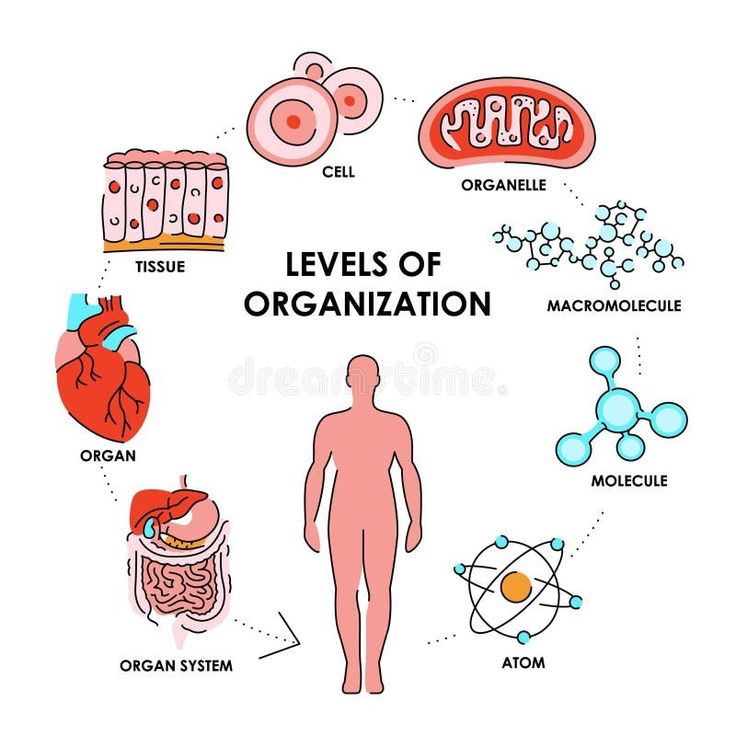

We all know that atoms are the smallest unit of measurement, and that they make up everything (pun intended), but what about the rest?
For the purpose of this page, we are using items within the body to showcase the size comparisons of each item included. Within the body, there are 5 main levels of organisation, and each represent a part of the body that eventually make up... well, you.
Let's start with the first one.
Cells are small. Literally, a microscopic sized component that eventually make up a tissue. In the human body, there are many different types of cells, each with a separate function. You can find out more specifically about cells using the link below:


Take an in-depth look at what a eukaryotic cell looks like, what's inside and how it all functions.

There are more than 5 levels of organisation. Examples include the smallest measurement in atoms, to a higher level of population, community and ecosystem in terms of ecology.
The following still is from a video on levels of organisation, with the following details:
Please click on the image to view the video.


Tissues are made up of lines of cells. The cells form together to make an area that is called a tissue.
An organ is a collection of tissues that are bound together in order to perform a function. An example of this (and usually the most common one students will mention) is the heart. It has a specific function (to pump oxygenated blood around the body) and only carries out this function.
An organ system (our body has 12 in total) is a collection of organs that work together in unison to perform a function. There are a few organs that help more than one system (the liver, for example, which has over 500 functions), but mostly, they work independently, governed by the brain.
This is you - you are the organism. Or your friend, or a frog, a dog, a tree, a bird, a fish... the list goes on. The organism is the "end product" if you wish, that is life and consciousness itself, and is what we call humans, animals, birds, plants and more.


Yes, while humans and animals have their own version of levels of organisation, ecology too serves a purpose within this. There are many examples you can find on the Internet where it has cells, tissues, organs, etc, and it continues with population, community, ecosystem and biome. This is the extension that ecology serves due to us being part of the wider world.
Equally, there are also two smaller units than the cells. These are molecules, which form together to make the cell, and atoms, which are the smallest (and never seen) unit of measurement. Atoms literally make up everything.
Order the levels correctly.


